
For most mid-market leaders, the problem is not a lack of AI experiments. It is the quiet graveyard of pilots that technically succeeded, were demoed proudly and then never made it into day-to-day operations.
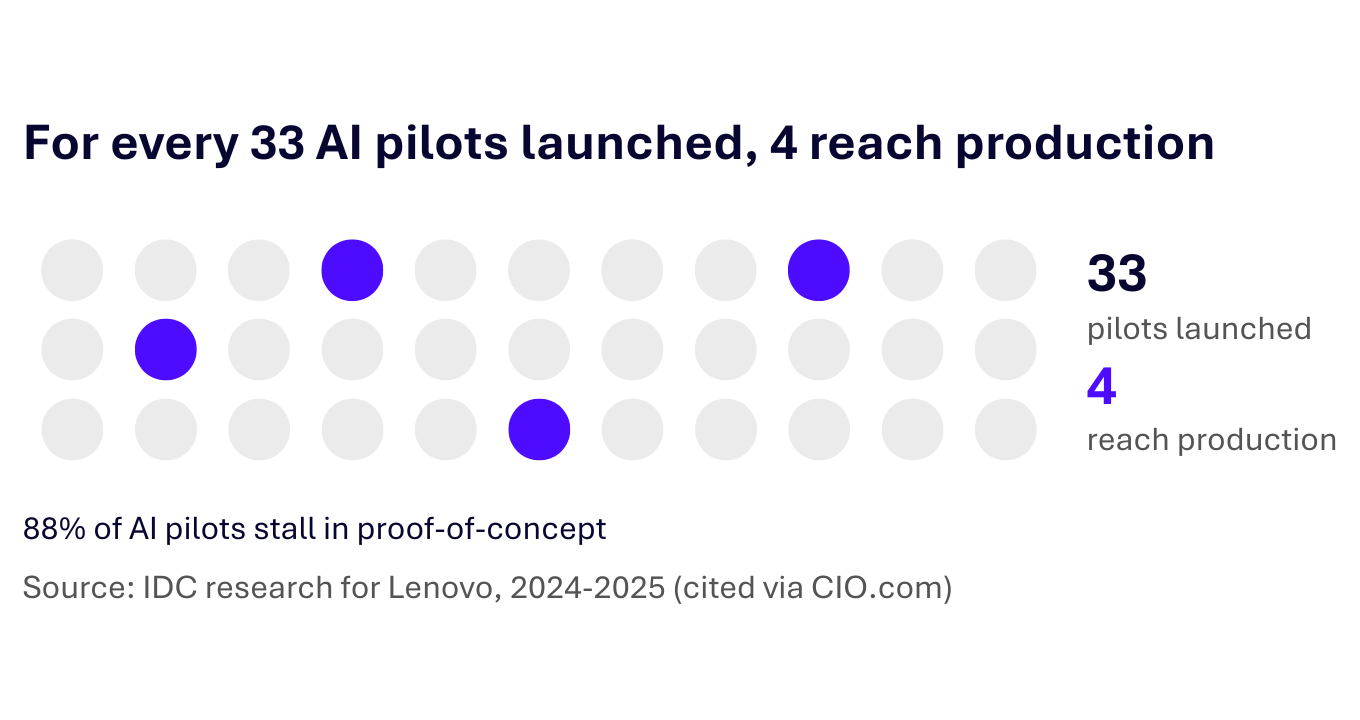
International Data Corporation estimates that for every 33 AI proofs-of-concept launched by Australian businesses, only four make it to production. The other 29 stall in procurement, integration or change-management limbo.
What actually kills AI pilots
Once you strip away the technical detail, the same patterns show up:
- Use cases chosen on excitement, not production-readiness.
- No clear path from sandbox to live workflow.
- Data infrastructure that cannot support a real-time service.
- Change and process design treated as an afterthought.
Most leaders experience this as a general sense that "IT is slow" or "the business isn't ready". In practice, it reflects a missing design step between proof-of-concept and production: how will this actually live inside your existing processes and controls?
Implications for governance and data
From a risk and governance perspective, stalled pilots are a double cost. You carry the spend and political capital of the experiment, without any of the productivity or control benefits that come from a production system you can monitor and govern.
An AI initiative that never leaves the sandbox is also an initiative that never benefits from your normal disciplines: logging, access control, change management and incident response. The work has touched business data, just not in a form your existing governance can see or support.
What to ask internally
If you already have AI pilots running, the questions to ask your team are simple:
- Which of our AI pilots are designed with a production home in mind?
- For each, what is the concrete path from proof-of-concept to "this is in someone's daily workflow"?
- What is blocking that path: data, integration, process redesign or governance?
This is the gap the CLAID AI Blueprint is designed to close: starting from the business problem, then working backwards to a roadmap where the path-to-production is built into the plan, not bolted on at the end.