

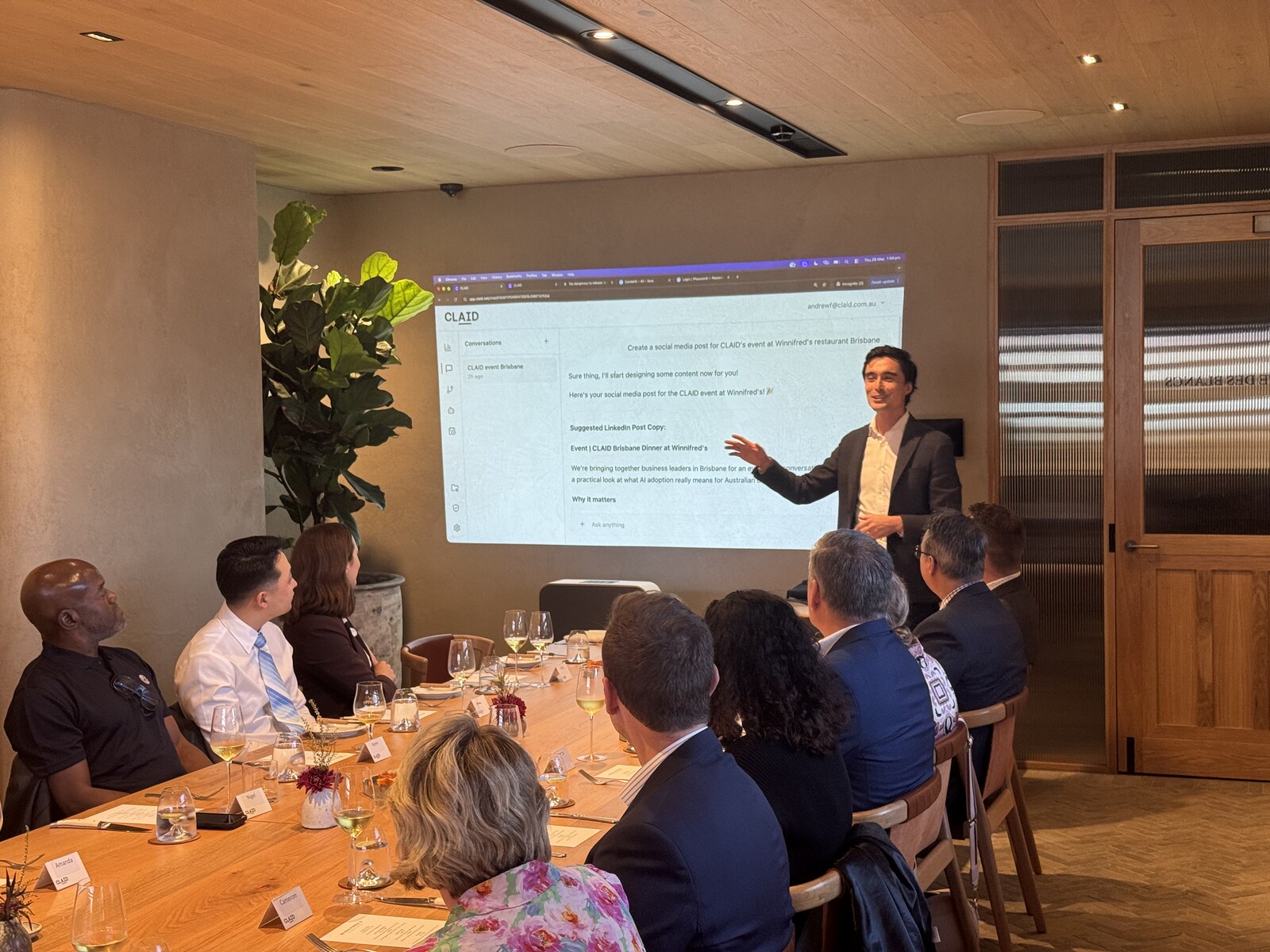
Senior leaders in financial services and legal know that AI matters. What is less clear is how to move from scattered experiments to something you can explain, justify and govern. Last Thursday, alongside NAB, we hosted a lunch with Queensland owners and operators to talk about what is actually working, where AI is falling short and what a more deliberate approach looks like.
The real question on the table
Around the table were senior leaders from financial services and legal practices who have already been exposed to AI in their businesses. The shared concern was not "should we use AI?" but "how do we use it safely and usefully, without losing control of our data or diluting our professional judgement?".
Most attendees had teams already experimenting with public tools, vendor add-ons and internal pilots. What they wanted was a way to bring this activity inside their own environment, align it with their existing risk posture and make sure it actually moved the dial on capacity, margin and client experience.
What we're seeing in regulated businesses
We shared what we are seeing across mid-market regulated organisations: leaders are trying to create capacity without headcount, while keeping a firm line on confidentiality and compliance. In many firms, highly skilled people are still spending half their week on work AI can now do in minutes: triaging documents, preparing first-pass analyses, reviewing contracts against playbooks or drafting structured responses.
That is both the problem and the opportunity: every hour spent on reactive work is an hour not spent on higher-value counsel, client strategy or complex matters. The competitive pressure is already visible. The Big 4 and major firms have been deploying AI across advisory since 2024; they are not just experimenting, they are building it into how they deliver their services. For mid-market organisations, the question is no longer whether to respond, but how quickly and on what terms.
Private AI in your own environment
A central theme of the session was the difference between experimenting in public tools and running AI as part of your core operating environment. We walked through CLAID's approach: a Private AI platform built for regulated Australian businesses, deployed in the customer's own environment and governed alongside their existing systems.
Practically, that means three things leaders can explain to their boards and risk committees: your data stays in your environment (no vendor logs, no training on your inputs and data does not leave Australia), every interaction is logged and reviewable (creating an audit trail for each query and output) and the AI is integrated where work already happens, across your existing systems and documents.
Capacity released by AI only matters if it is deliberately redirected into higher-value work, not absorbed into more low-value tasks.
From experiments to a deliberate blueprint
The CLAID AI Blueprint is a structured way to move from scattered pilots to a focused plan. The Blueprint helps organisations identify where AI can create meaningful capacity in their business, how to deploy it in line with their governance and what to prioritise first.
For mid-market boards and executive teams, this kind of blueprint provides clarity and a common language. It turns AI from something that is happening in pockets across the organisation into a defined program of work, with clear use cases, ownership and expectations, rather than a collection of unconnected experiments.
What leaders took away from the lunch
The discussion confirmed a few patterns we are seeing more broadly. First, most organisations already have enough "demand" for AI in the business; the gap is a safe, governed way to meet it. Second, capacity released by AI only matters if it is deliberately redirected into higher-value work, not absorbed into more low-value tasks. Third, once AI touches meaningful client or business information, leaders want it running in an environment they can govern as confidently as their other core systems.
For most, the most practical next step was not "rolling out AI everywhere", but choosing one repeatable use case, proving the value and controls and then scaling with a clearer story for their boards, partners and clients. That is where a private AI platform and a simple blueprint for where to focus can add the most value in the next 12-18 months.